
The bunker balancing act
We spoke to three course managers about how they maintain, develop and pay for their bunkers.
Meet the panel:

Name: Simon Bell-Tye
Position: Course Manager
Club: Skylark Country Club, Hampshire
About Simon: “I’ve been here 12 years. The course is privately owned by First Golf (Hampshire). Skylark’s an 18-hole complex and we’ve got 40 bunkers.”

Name: Kerr Rowan
Position: Course Manager
Club: Kilmarnock (Barassie), Ayrshire
About Kerr: “I’ve been course manager coming up two-and-a-half years. I was a junior member at Barassie, moved around different parts of the world with greenkeeping and had the chance to come home. We’ve got 27 holes on the two courses and in the region of 140 bunkers.”

Name: Graeme Roberts
Position: Course Manager
Club: Hayling, Hampshire
About Graeme: “I’ve been course manager at Hayling for just under three years and I was deputy for a year-and-a-half. I’ve been greenkeeping for almost 20 years. Hayling is a links course on the south west of Hayling Island – one of the few links courses on the south coast between Kent and Cornwall. We have 59 bunkers on our course.”
How crucial are bunkers to the overall challenge of your course and its character?
Kerr: At Barassie, to make it a challenge, they’re crucial. They’re important for strategy – how you plot the hole or how the hole is meant to play. There are courses down south with no bunkers, which sometimes feels like a dream, but they’re very important for us.
Graeme: We’re flatter than a lot of links courses and we don’t get as much growth in our rough as some courses – because of the dry nature of our location. The bunkering does play quite a big part in the design of our course. We have a master plan with [architect] Tom Mackenzie that was put together in 2011 and then revamped in 2023 that has included the relocation, redesign and assessment of our bunkering size and style to match that of the modern golfer, as well as favouring the traditional design of the course from the 1880s.
Simon: They’re massive here because the course is only 5,700 yards. It’s not a long golf course so the bunkers provide protection. We’ve built them with EcoBunker and they’re quite a feature of the hole. We were bought by First Golf in 2023, and the first thing they noticed was the bunkers. We took a few out that were in the middle of nowhere and we’ve probably added eight or nine since I’ve worked here. They pop, and when you stand on the tee, especially when the sun is going down and you get all the shadows, they’re lovely.
How much time do you spend maintaining your bunkers? What does that involve?
Simon: It’s not a big team here – myself and four others – but it works fine and we rake the bunkers pretty much every day. It can take us about six hours a day. It’s two guys and three hours [each]. We smooth rake the outsides and the middles are all groove raked.
Graeme: Typically, Monday to Friday, we’ll have two members of staff fully raking our bunkers every day. That typically takes them about four hours each. That does include our tee setup as well, so you can probably take about an hour off each of those. It’s one person fully raking bunkers over the weekend – we haven’t got the full team of staff in every weekend. Apart from the very depths of winter, when we’re doing our winter projects, we generally fully rake every day – apart from the odd occasion when we might footprint them. As part of the overall quality of the course, we want the bunkers to present as well as the rest of the course, day-to-day for visitors and members.
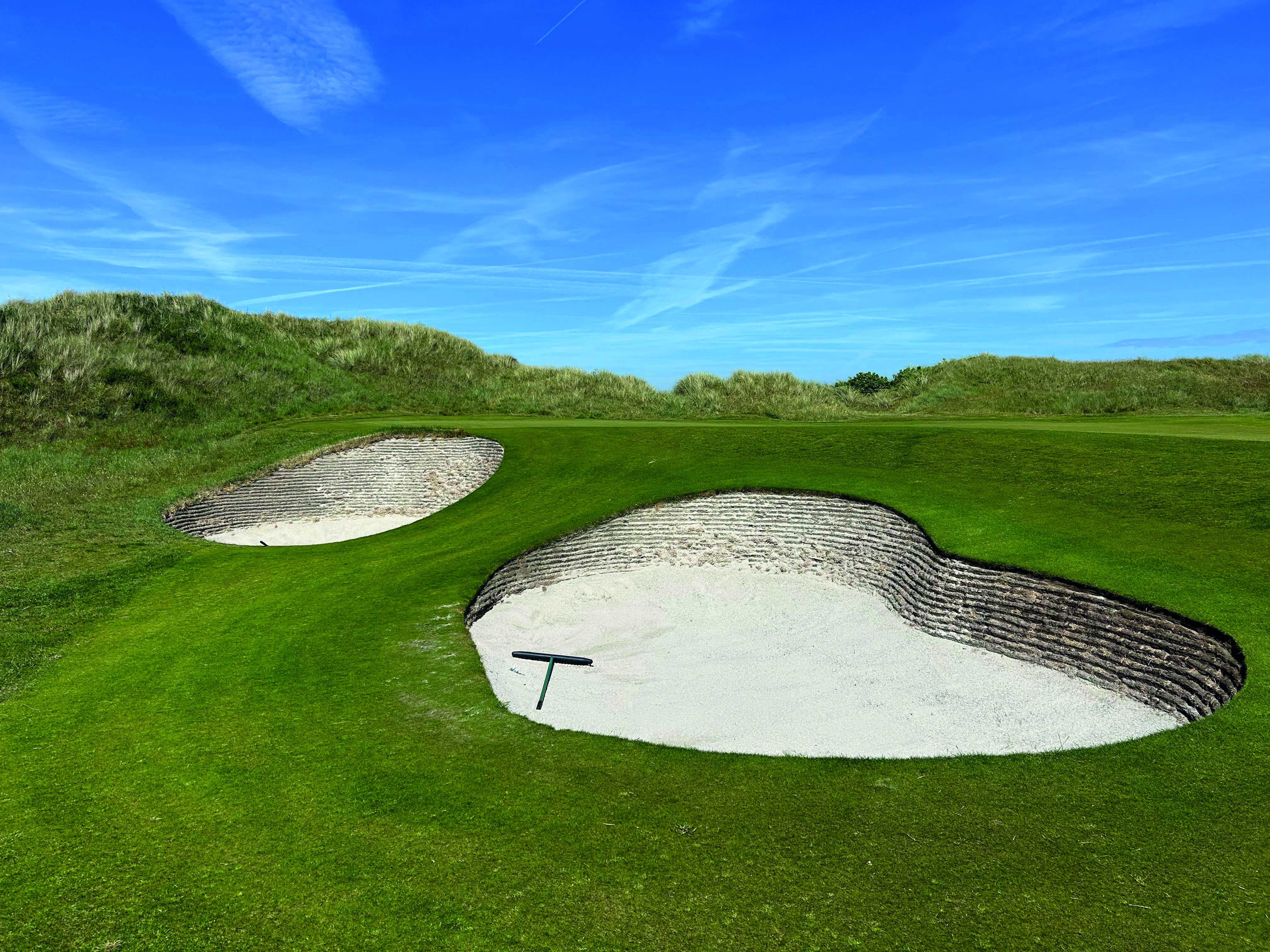
Kerr: Daily, we’ll have two-and-a-half guys raking for about four hours. We must be raking bunkers 10-to-12 hours a day. We’ve got other priorities in the winter, so we probably don’t rake quite as much. It probably takes 100 hours a month just to trim them and cut them.
What type of sand do you use in your bunkers and what are the costs?
Graeme: We used to use native dune sand, which I know a lot of English courses use, but where the site is a Site of Special Scientific Interest (SSSI), Natural England eventually stopped us from using that. We transitioned and because our site is exposed to wind, we went with cross china clay. It’s a slightly coarser sand but it compacts quite well, so it gives us quite a firm base to play from. It drains very well if we do get excessively wet, and it isn’t as susceptible to wind blowing anywhere near as much as the native sand we have on the site. It rakes up very well. We typically budget for around 30 tonnes of bunker sand a year, and that tops up bunkers throughout the season as well as any bunker work we do, where we would rebuild bunkers and change that sand out. In the grand scheme of our budget, the cost of the sand itself is minimal. It’s more the labour hours and the time spent managing, maintaining and presenting our bunkers. That’s where the biggest cost is.
Kerr: We’ve got a few pockets of our own native sand, so we’re using our own. We’ve had it all tested, but if you went to buy it, it’s probably not 100% perfect. It’s probably a little bit too fine, but the cost of sand – a ballpark figure – is about £40 a tonne so the savings are absolutely astronomical. There’s also the sustainability of not having to haul it here and saving on diesel and everything else that goes with it. The small compromise in playability is totally outweighed by the cost and doing the right thing for the environment.
How are your bunkers constructed? Are they natural or revetted?
Kerr: When I started, every single bunker was revetted. A revetted bunker lasts roughly five years depending on if it’s facing the sun and how much it’s been played. We’d need to do 25 bunkers a year to maintain the status quo. I think we’d done three in the three winters prior to me [arriving]. It’s a monumental ask with the turf nursery, the amount of people and the amount of golf we have. This winter, we decided to naturalise some of our fairway bunkers, and we’ve done that on the 1st, 2nd and 3rd on the main course. There were a few reasons. They were in the wrong place, and we wanted to move them for modern-day golf. They were revetted and pot so they were really quite penal. And because a revetted bunker only last five years, we just didn’t have the resources to do the course justice. With a naturalised bunker, we’re hopeful that it’s a bit gnarly and straggly and we only have to redo it every 10-to-15 years, so that will give us the time to concentrate on the revetted greenside bunkers.
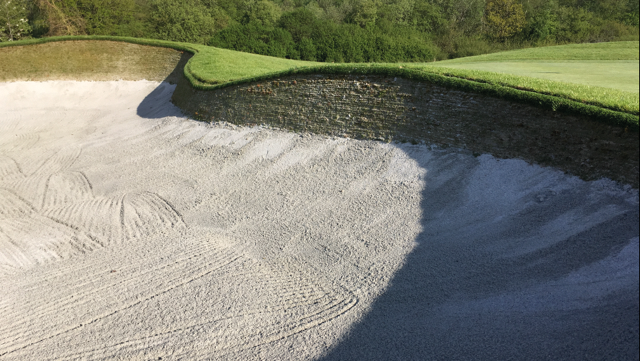
Simon: When I came here, the bunkers were just scoops out of the ground with some sand in them. They looked awful, and the owner at the time really wanted to improve the bunkers. I’m a member at Royal Winchester and they had used [artificial] EcoBunker. He really liked the look of them, and we built two on our 11th. They were the worst two bunkers on the course, and they really popped. What’s lovely about them is we line them and then build the wall on top of the liner. You build a shelf and then build up in a brickwork fashion. You’ve got a nice artificial wall with a liner, and then I use an artificial strip batten that’s screwed to the top of the last revet and is backfilled with soil to the top of the batten. My maintenance is just raking bunkers. I can run a mower pretty much all the way around them. I use a strimmer three or four times a year and edge them up to stop any lateral growth. The maintenance of edging my bunkers is minimal. Sometimes, at the beginning of the season, where you get a bit of moss over the winter, we spray them off with some iron and then brush or string the faces. That’s pretty much all I do with them.
Graeme: The site is based predominantly on shingle, so if you go to below two inches on some of our fairways, you are through the soil and it’s straight shingle. The issue we face is stone migrating up into the bunker sand. The worst nightmare for us would be stones in the bunkers because that becomes a colossal maintenance issue to clear that stone out of it. All bunkers on our site are built with a fibre geotextile liner. All we’re looking for is something that separates the natural profile of the soil from the bunker sand on top. It’s purely just a physical barrier to stop that but still allows rainwater and irrigation water to drain through. Our bunkers are all built naturally. They’re predominantly revetted bunkers around the greens and, as part of a sustainability push for us, the majority of our fairway bunkers – or those situated a bit further away from the greens – are hybrids. There is a more natural rough grass edge, and they might also have flares and essences of revetted bunkers to create a bit more interest. But from a resource point of view, the actual construction of the bunker is a lot less costly for us. With a lot of revetted bunkers, particularly where we are on the south coast with a lot more dry periods as well as the wind, our bunker longevity can range anything from three-to-five years before they need a complete rebuild, so these natural bunkers we’re building last significantly longer.
What’s the one thing golfers could do to make your lives easier when it comes to bunkers?
Graeme: It’s where they walk in and out of the bunkers. We find a lot of damage is based on them taking alternative routes and that can create quite significant damage over time. But I’d say the biggest thing would just be leaving them how they found them. If they understood how they would want the bunker to be if they found their ball in it and they left it the same way, that would make life a lot easier for everyone.
Simon: The first would be just to rake them. But the way to rake them, in layman’s terms, is push and don’t pull. If everyone pulls the sand, they just pull it out to the back and that’s when you get all the sand at the back of the bunker. Members go in, hit their shot, grab the rake and just drag the sand from the green side of the bunker towards the back. They’ll rake and then drop and you get these ridges. But if you just brush the sand towards the pin, you’ll get a lot fewer ridges or waves in the bunker and the sand will rake pretty much smoothly.
Kerr: This maybe slightly silly but the best thing they could do is use two hands to rake a bunker. I see golfers all the time one-handed raking a bunker, and none of the greenkeepers I know do it. If they just use two hands and take a tiny bit of time, then the bunkers will be so much better. If they’re raking one-handed, they’re shifting a lot of sand backwards. If they’re in a bunker, they’re probably not that happy about it because they know it’s a hazard and it’s not where you’re meant to be. But if they can just shake that off, take a bit of time and use two hands, we’d be in a better place.
Author
