
Faster is not always better: Why speed, moisture and ball roll quality must be read together
Heiko Siegfried, greenkeeper at the Golf and Country Club Seddiner See in Germany, conducted an academic field study called GRÜN as part of his advanced professional qualification in golf course management. His goal? To examine how moisture, speed, smoothness, trueness, firmness and surface condition interact in the overall performance of a putting green.
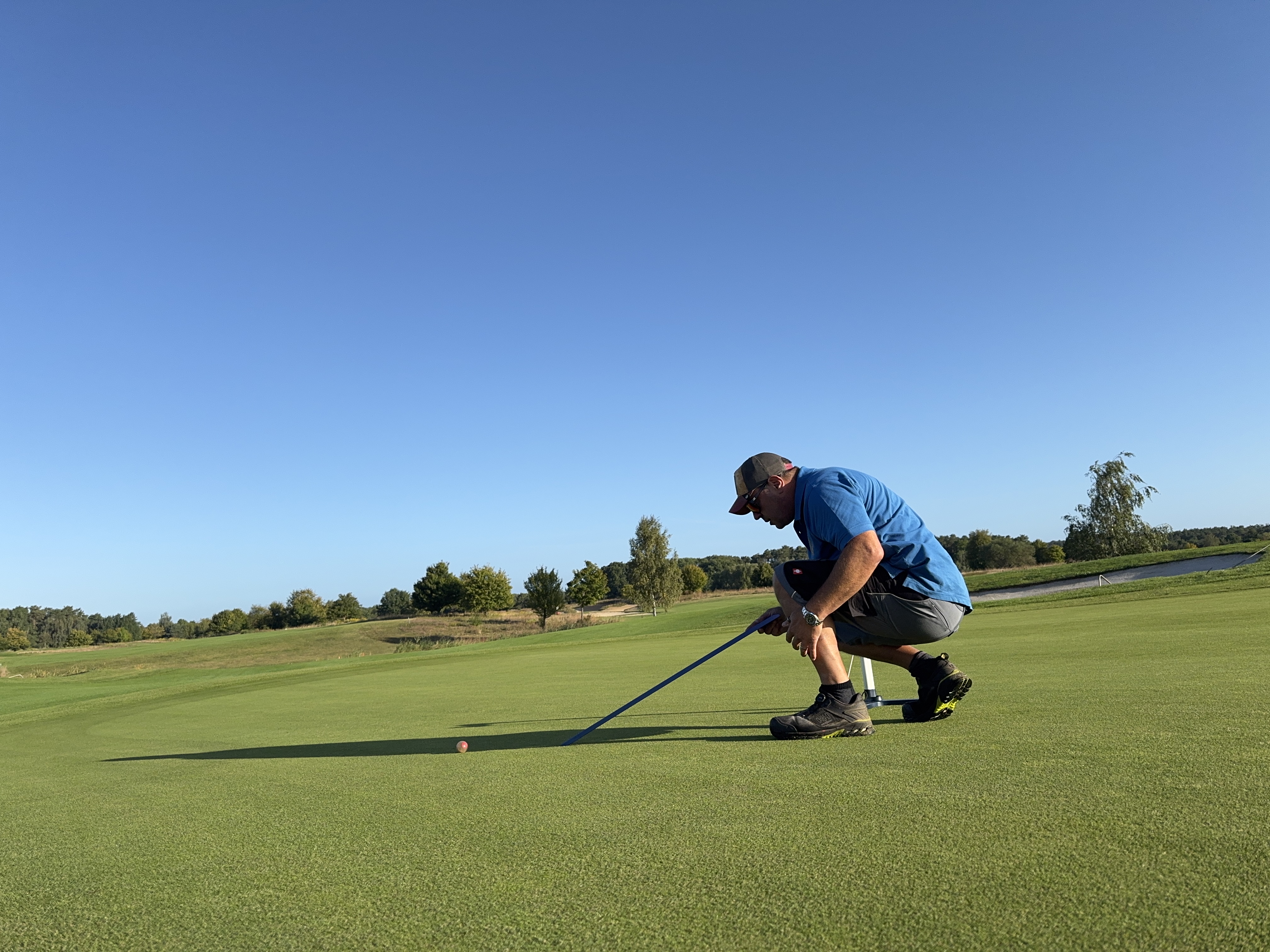
As both a greenkeeper and an ambitious golfer playing off 6.6, I often hear two simple judgements: the greens look good, or the greens are fast. Both may be true, but neither tells us whether the ball rolls smoothly, holds its intended line or reacts consistently to a well-struck putt.
This article presents the findings most relevant to everyday greenkeeping. Please note that the full GRÜN study is considerably more extensive and contains the complete methodology, statistical analyses, model comparisons, uncertainty assessment and full data tables.
I wanted to stop searching for the driest or fastest green and instead examine together: green speed; smoothness; trueness; firmness; visible surface condition; and volumetric water content (VWC).
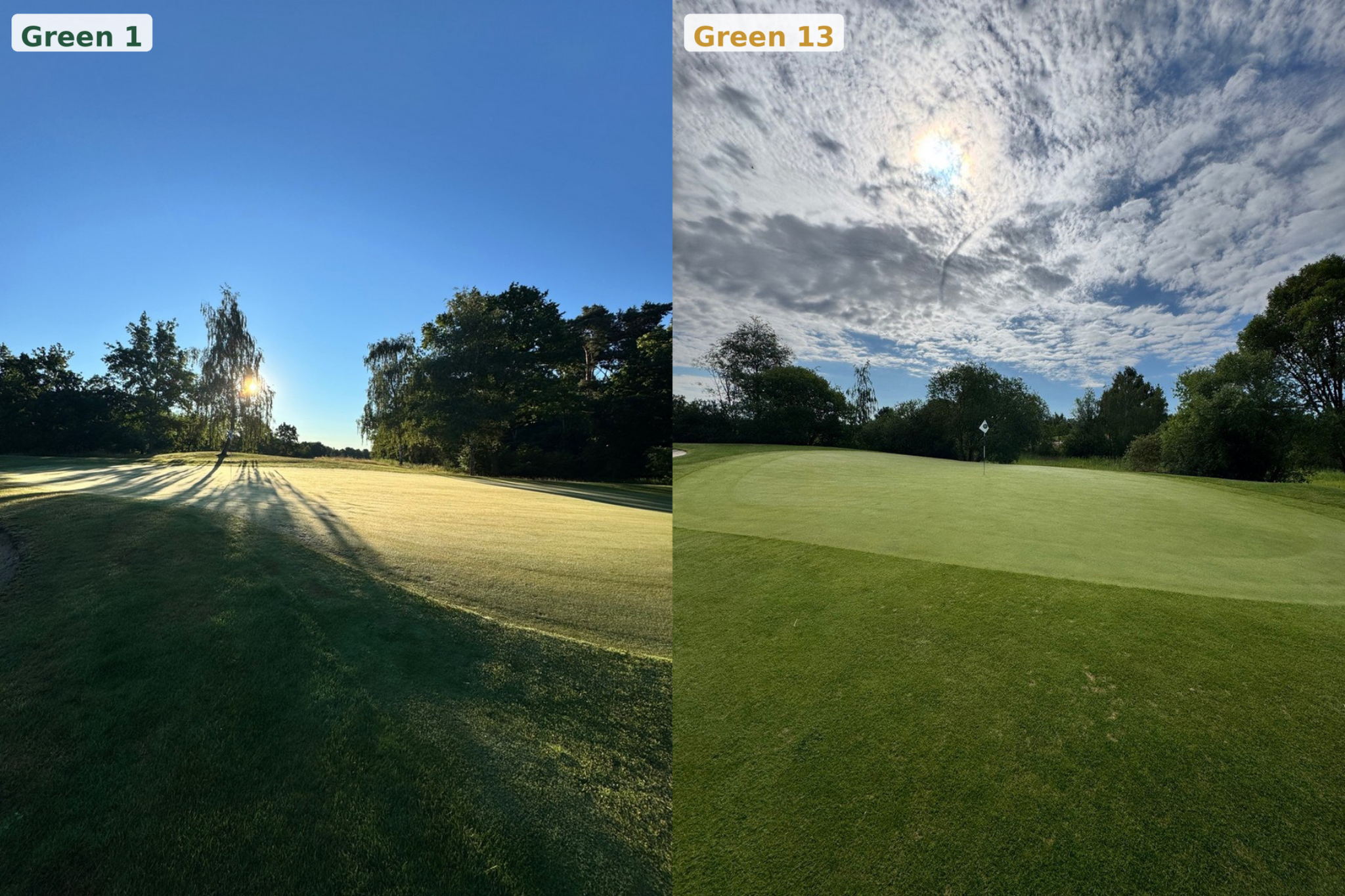
The result that reframed the question was as follows: the green on the 1st was the driest and fastest of the three study greens; the green on the 13th had a substantially higher mean VWC and was slightly slower, yet its ball roll was smoother and truer.
That contrast became the central lesson of my field study: a single favourable number cannot describe the overall performance of a putting green.
How I conducted the study
The study followed greens 1, 3 and 13 on the South Course of the Golf and Country Club Seddiner See. They were deliberately selected as contrasting microsites within the same maintenance system. The data set contained 84 complete green-by-date observations: three greens measured on each of 28 shared dates.
The work had two parts: a surface recovery phase covered four dates and 12 observations while the turf canopy was still recovering early in the season. A later VWC focus phase covered 24 dates and 72 observations after the surface had largely regenerated.
I measured VWC with a POGO Pro+ and recorded green speed, smoothness, trueness and firmness with the USGA GS3 Ball. Green speed is reported in feet. Lower smoothness and trueness values indicate a smoother and truer roll. Firmness is reported as penetration depth in inches, so a higher GS3 value indicates a softer surface.
I also assigned a four-level surface condition score. A score of 1 described a very homogeneous, closed surface; 2 indicated slight unevenness or isolated gaps; 3 represented significant damage, visible disease symptoms or wear; and 4 represented a severely disturbed surface. The score provided visual context rather than a substitute for objective turf health or disease measurements.
The measurements were repeated in the same practical zone on each green so that moisture and playing performance referred to the same area. The study was observational and exploratory. It describes site-specific response patterns, not universal causal relationships.
The reported VWC values refer to the standardised measurement time at approximately 12 noon. They therefore represent a snapshot of the moisture condition at that time rather than a constant value throughout the day. Following early morning irrigation, VWC may initially be higher and can change over the course of the day through drainage, evaporation and transpiration. This is particularly relevant on sand-based putting greens and should be considered when interpreting the absolute VWC values and the observed candidate range.
Recovery before moisture
Separating the two phases was essential. During early recovery, mean VWC was 23.99 per cent and mean green speed was 8.68ft. In the later phase, mean VWC was higher at 28.52 per cent and green speed averaged 9.38ft. Between the two phases, smoothness and trueness also improved markedly alongside visible surface recovery.
Green speed increased between the phases, but the study cannot separate the effects of recovery, mowing height, weather, routine maintenance and use. The result therefore does not show that higher moisture caused faster greens. It shows why the improvement should not be attributed to VWC alone. During recovery, visible surface condition was more closely associated with trueness, and to a lesser extent smoothness, than VWC was.
Two greens, two performance profiles
The clearest comparison came from green 1 and green 13 during the VWC focus phase. Green 1 averaged 25.35 per cent VWC and a green speed of 9.53ft. Green 13 averaged 33.19 per cent VWC and a green speed of 9.13ft. Judged only by dryness or speed, green 1 would have led.
The wider profile told a different story. Green 13 recorded more favourable smoothness and trueness values of 2.75 and 0.54, compared with 3.05 and 0.68 on green 1. Its firmness reading was 0.485in, compared with 0.456in on green 1. Because the GS3 value represents penetration depth, the higher figure indicates a softer surface.
Neither green was simply better. green 1 was drier, faster and firmer. Green 13 was wetter, slightly slower and softer, but smoother and truer. The comparison revealed different performance profiles rather than a ranking.
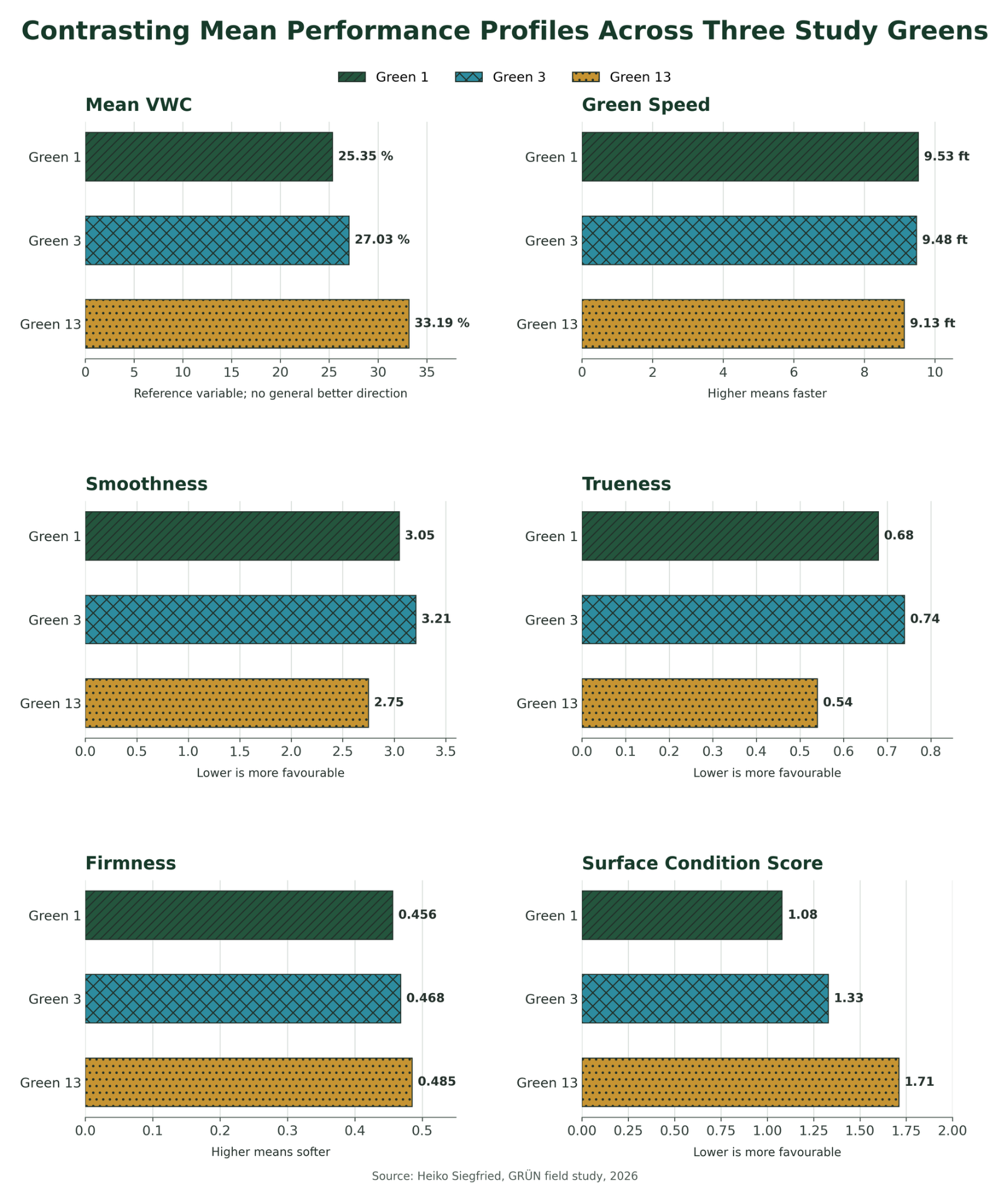
Contrasting mean performance profiles across three study greens
When the three greens were pooled, VWC appeared to be associated with several performance measures. However, these associations weakened markedly when each green was compared with its own average. The pooled pattern therefore reflected differences between greens more strongly than a consistent moisture response within each green. The same VWC can therefore be associated with different performance profiles on different greens.
Finding a 'green performance corridor'
To turn the multidimensional assessment into a working method, I developed the 'green performance corridor'. It is not a USGA definition and not a single ideal moisture number. It describes a site-specific working range in which several operational objectives are met simultaneously while surface condition remains acceptable.
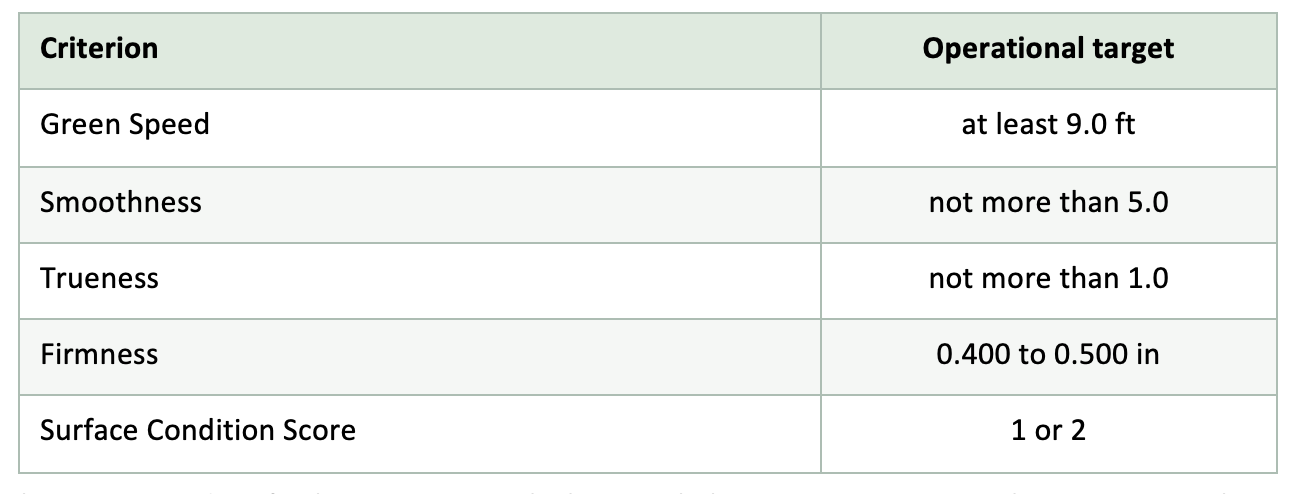
Operational criteria used in this study
The green speed threshold of at least 9ft was defined as a study-specific operational criterion for this exploratory analysis. The smoothness and trueness limits were also operational thresholds used in this exploratory analysis and informed by published USGA guidance, not official universal standards. The firmness range drew on published USGA reference material and was used operationally, while surface condition scores 1 and 2 were study-specific criteria.
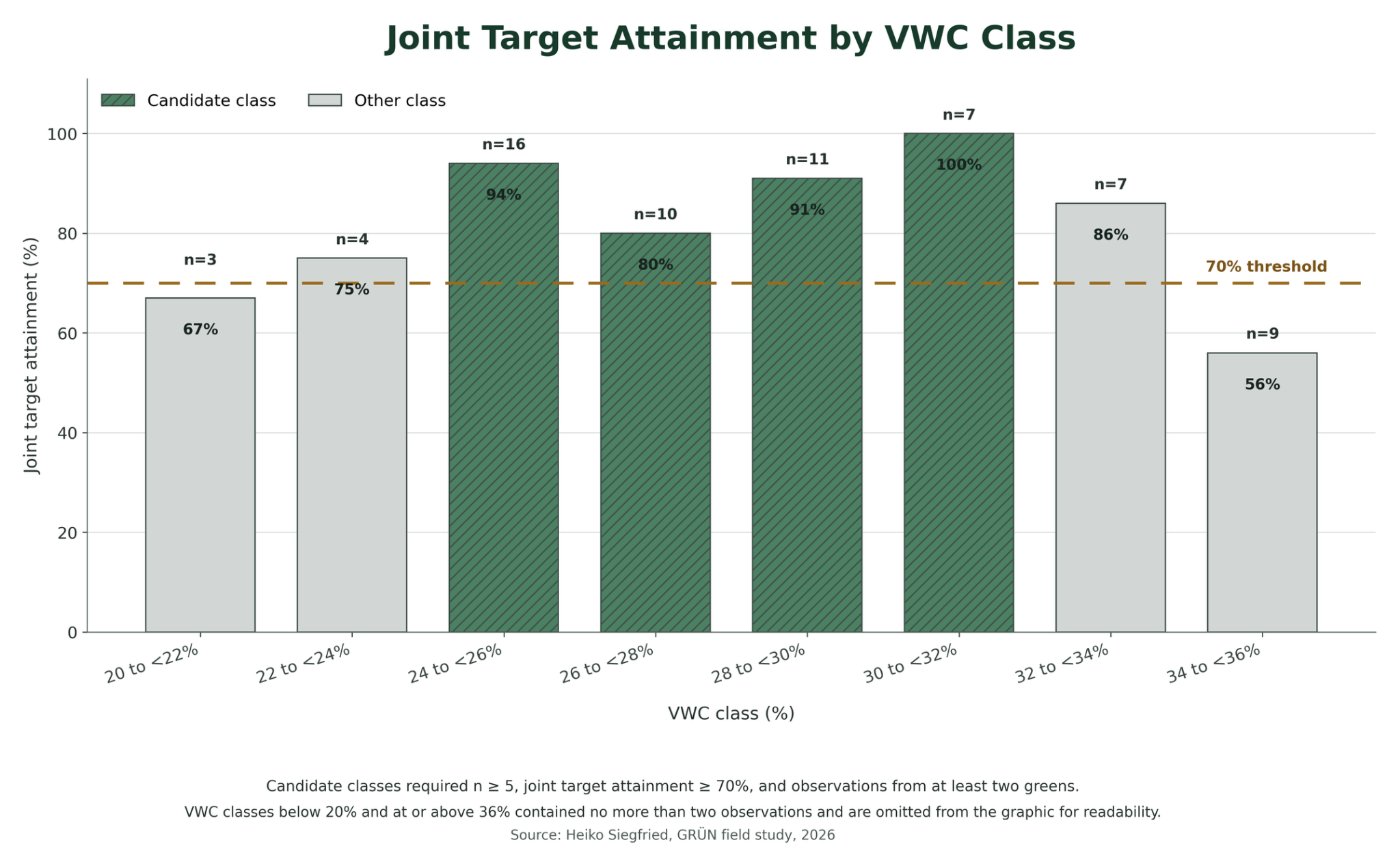
In this data set, high joint target attainment extended from 24 per cent to below 32 per cent VWC. Candidate classes required at least five observations, at least 70 per cent joint target attainment and representation from at least two greens. The 30 to below 32 per cent class contained observations from greens 3 and 13 only. The 32 to below 34 per cent class reached 86 per cent joint target attainment but represented green 13 only, so it was not treated as a candidate class. The 22 to below 24 per cent class reached 75 per cent but contained only four observations and therefore did not meet the minimum sample size. The range is therefore exploratory and site-specific, not a universal optimum.
The observed candidate range must not be interpreted as meaning that a higher VWC generally produces better smoothness or trueness. No such causal relationship was demonstrated in this study. Just as a particularly dry and fast green is not automatically the better green, a particularly wet green is not automatically better either. What matters is how the performance parameters work together within the specific site context.
Joint target attainment by VWC class
The more useful finding is the method rather than the number: define a working range through joint target attainment, then refine it for each green.
What this means in practice
First assess whether the surface is sufficiently homogeneous, because gaps, damage or an uneven canopy can dominate ball roll. Then read green speed, smoothness, trueness and firmness together instead of allowing one favourable number to define the green.
Use VWC as a reference for irrigation decisions and for assessing moisture distribution, not as a quality judgement. Repeat measurements in the same practical zones and build a response profile for each green. Over time, that record can support irrigation and surface management while keeping the greenkeeper's observation and experience at the centre of the process.
Limits and the practical conclusion
This work covered one golf course, three deliberately selected greens and one season. Repeated measurements on the same greens are not independent replications from different facilities. The design did not isolate a causal effect of VWC, and the findings do not provide a universal irrigation recommendation. More seasons, wider spatial sampling and additional courses are needed to test how well the method transfers.
The best green is not automatically the driest, fastest or firmest. What matters is how well the performance parameters work together on that particular green.
Conclusion
Across the study period, the driest and fastest green was not the smoothest or truest. The practical lesson is to assess green speed, smoothness, trueness and firmness together, using moisture and visible surface condition as context.
Author


About the Author
Heiko Siegfried is a greenkeeper at the Golf and Country Club Seddiner See in Germany. The academic field study GRÜN was completed as part of his advanced professional qualification in golf course management. His long-standing interests include agronomy, turf management and the measurable green performance of putting greens.
He has been an ambitious golfer for more than 20 years, combining the perspective of course maintenance with that of a player. This combination of practical greenkeeping, professional interest and many years of playing experience formed the starting point for his study.