
Bringing Raglan back to life
This South Wales club is thriving after being taken over by new owners – who entrusted Lucy Sellick with overseeing the revival of the course.

When Lucy Sellick first visited Raglan Golf Club, the course was barely recognisable. The greens had been re-turfed and machinery dotted the landscape, but the site was essentially a construction zone. For most, the scale of the challenge might have been daunting. For Lucy, it was an irresistible opportunity.
A BIGGA board member and respected industry professional, Lucy had previously worked at venues like Celtic Manor and Saltford, before moving on to become head greenkeeper at Wenvoe Castle. Yet the prospect of bringing Raglan back from dormancy, reviving a once-thriving club with a proud local reputation, felt like a challenge worth embracing. It wasn't just about restoring what had been lost; it was about building something new and inclusive.
Raglan is now privately owned by two local couples, who have committed to a long-term 'golf for all' vision. From the beginning, they placed their trust in Lucy to guide the redevelopment with the care and precision it deserved. With limited time and resources, she and her small team set out to do just that. Nearly a year on, the results speak for themselves. Membership is booming, the course is in fine shape, and a strong community ethos underpins every decision.
Here, Lucy reflects on what it took to bring Raglan back to life, from the hands-on labour and logistical challenges to the pride of shaping something with real legacy.
How did the opportunity to take on this project at Raglan come about?
I got a phone call asking if I'd be interested in a redevelopment project. The family behind the club had heard about my background, my time at Celtic Manor and that I'd built my first golf course, Virginia Park, while still attending school.
They asked for my CV on a Thursday. I sent it, and by the weekend I had a call asking if I could visit the site that Monday. When I got here, it was a construction zone. The bones of the course were there and the greens had been re-turfed, but they had a three-man team that wasn't quite getting them to where they wanted to be. Three hours into that first visit, they asked if I was interested in the role. I said I'd go home and think about it. We had contract talks on the Wednesday, I was back on site that day, and I handed my resignation in at my old job on the Tuesday. So it all happened in under 10 days and I started in mid-September last year.
A lot of people might have seen it as a daunting task – what made you take the plunge?
There was definitely pressure, especially when they said they wanted to open on March 1st. Projects like this usually take 18 months to two years, and they were aiming for under 15 months, with me only having seven months to the opening date and a winter to get through.
But I wasn't intimidated. Their passion struck me. I asked them three questions: why they wanted to do it, whether they owned the land – because lease issues had been a problem before – and what the committee involvement would be. Once I got those answers and saw the scale of their investment and their vision, I wanted to be part of it. Raglan has always had a great reputation and the layout is superb. The surroundings are beautiful. I was blown away.

Can you explain the ownership model?
It's two local couples – two sisters and their husbands. They saw the land was for sale and decided to buy it. They admitted they didn't realise the full scale of what would be needed, especially in terms of machinery, but they wanted to reopen it to a high standard. They have a real 'golf for all' vision. It's about community, not just members – a local coffee shop vibe, a village feel. Golf for everyone.
How much say did you have in the course’s look and feel?
At that first meeting, I said, 'It's your house – I won't tell you what colour paint to buy, but I'll tell you what paint is needed and how it should be applied'. They liked that approach. I treated it like I was looking after their investment, not spending for the sake of it.
They weren't from a golf background and only started playing after taking on the project. So they really trusted me – staffing levels, mowing styles, everything. I always gave them three options and explained which I thought was best and why. They've been hands-on from day one, helping with turfing, maintenance, even firming up greens and changing composition. The buy-in has been total.
What size of team have you been working with?
We're six now, plus one of the family who worked with us during construction. He still pops in a few days a week – loves the site. We also bring in contractors when needed.
Were there any big surprises or setbacks along the way?
Not really. I remember saying in October that we'd hit a point where we needed to stop construction and focus on turfing and germination, but we kept pushing and ended up laying about 5,000 rolls of turf to hit our target. We missed the March 1st opening because of a clubhouse delay, not the course. In fact, around Christmas, I decided to build another five bunkers because we had such a kind winter.
When you did open in April, how were the nerves?
As greenkeepers, we always beat ourselves up. There were things I wanted to do, like overseeding in spring, but the weather didn't allow it. That said, by March we were pretty much ready. The clubhouse delay gave us a chance to run guided tours in March. We expected three tours a week – we ended up doing two or three tours a day. The interest was huge. By the time we opened in April, we had 200 members, and within three months we were at over 450.
How much of what you've done would be considered restoration versus reimagination?
The layout remains the same. The front nine had been kept in reasonable condition, but the back nine had rewilded. We had to bring it back – robot mowing, silage cutting, drainage and re-turfing greens. We reworked bunkers, some removed, some added, and made similar changes with tees. With six months to work, we focused on what could be done well in that time.
Has the heavy lifting now been done, or are you still in development mode?
We've finalised our winter plan and I've presented our development roadmap to over 120 members. It shows where we were, where we are, and where we're going. We're reconstructing three sets of tees and adding four more bunkers. It's about continuous improvement now. We've already installed nearly five miles of drainage, recut outlet ditches and exposed over 20 original drain lines and will add secondary drainage in-house when conditions allow.
You must be keen to make sure your team are getting their due credit amid all this work?
Absolutely. We recently hosted a tournament for the Gwent Boys and the attention to detail from the team was incredible. I make sure they know that the praise is for them. Yes, I beat myself up, but the positive feedback gets passed straight to the team and we do take time to remind ourselves of what has been achieved already and in a remarkable timescale.
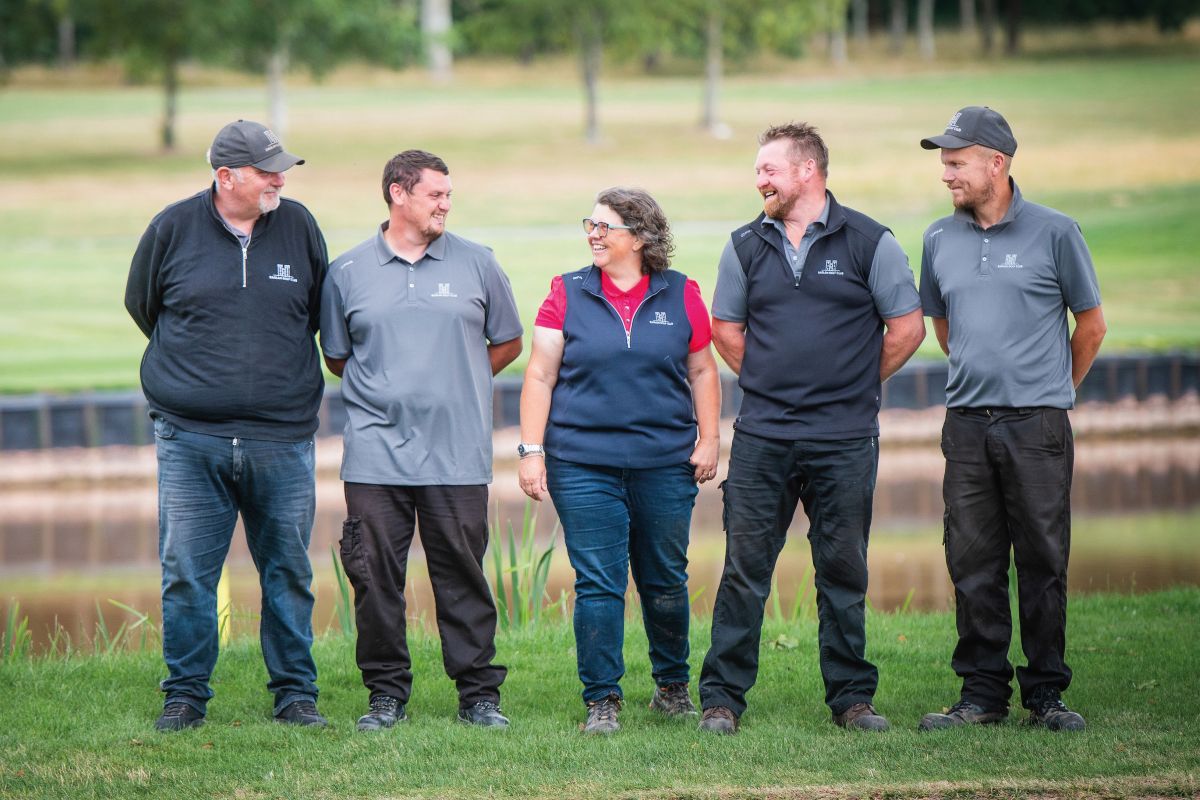
Team L-R: Lee Sellick, Keiron Cook, Lucy Sellick, James Towner, Chris Herbert
Did your team already have the skill set for the scope and scale of this work?
Yes. Two of them had worked with me before and have been brilliant. We're now upgrading irrigation, and they have the experience for that. Another has a background in grounds and woodwork, so he's been great with sleepers and steps. One has a farming background and is fantastic with tractors. It's an unusual mix, but their skill sets complement each other perfectly.
Have 'off-course' elements like ecology and community engagement also been on your radar?
They were from day one. The village had a community event at the football fields and the owners wanted to take part straight away. Most of the people there weren't golfers, so we set up a golf net, ran competitions, gave out prizes. It was all about getting people involved. We've got a bike rack on the patio to encourage non-golf visitors, and installed a playground and mini golf so the site is family-friendly. We're also exploring grants for tree work and hedgerow planting on newly acquired land.
On ecology, we were really careful during the barn reconstruction, making sure we had the right bat licences. We've put up bat boxes and we've got seven lakes on site, so being good custodians is a big focus.
You've played a big part in reviving a respected facility. That must be satisfying.
It really is. The owners say the course was a diamond – we've just polished it. One of the team said we've woken a sleeping giant. That really stuck with me. Right now, I'm sitting beside one of the lakes, just taking it all in. I'm really proud. We've made a lasting impression. GI
'Think like a project manager'
Plan meticulously – 30-, 60-, 90-day plans are essential. But also expect things to go wrong. The biggest frustration for me was delivery times, materials held up due to logistics. You need to think like a project manager. The weather's a factor too. We had a dry spell and used it to move materials, even if it meant dumping them in random places. It let us keep working when it got wet. Flexibility is vital. Also, communicate clearly with owners. They'll see 90 tonnes of soil piled up and wonder why, so explain the plan. Keep them in the loop. And don't neglect your team. Sometimes all it takes is a bacon roll or just being honest about the tough jobs. We all muck in and get it done.
Being on the BIGGA board a 'win-win'
The owners spotted my BIGGA involvement on my CV and were impressed. They saw the value in the network I had and the advice I could call on. As a result, they signed the whole team up as BIGGA members. They support me giving up time to help improve the industry. That's always been my goal, to give back and help others. As a woman in greenkeeping, I also want to show what's possible. It's helped my professional development too. I've learned loads, especially in areas I was weaker in, like writing. And being on the board, seeing how people like Jim and Steve manage financials, has been eye-opening. It's a win-win. It helps me, and I hope it helps the industry too.
Author

The history of Raglan
First opened in 1994 as Raglan Parc, the club then offered an 18-hole parkland course, driving range, academy and clubhouse. It closed abruptly in November 2018 after the management failed to secure a lease renewal, despite attempts to buy the site. A new owner later took over with ambitious redevelopment plans, but progress stalled due to the pandemic and the collapse of investment.
This year, with new owners at the helm, the club fully reopened, boasting a mature parkland course set in the Welsh countryside, offering a par 72 over 6,700 yards. The course is set within the historic deer park of Raglan Castle and features a number of ancient oak trees and boulevards of well-established trees. The clubhouse, partly constructed of stone from the castle, has been newly designed and welcomes golfers and non-golfers alike.